Indonesian Vice President Gibran Rakabuming Raka Resigns
Gibran Rakabuming Raka has officially submitted his resignation as Vice President of Indonesia to the MPR amid political pressure and education document issues.
 Portal Islam



This article was first published in Indonesian. Baca versi Bahasa Indonesia →
The Vice President of the Republic of Indonesia, Gibran Rakabuming Raka, officially visited the parliamentary complex in Jakarta on Thursday (12/11/2026) to submit his resignation letter. This move comes amidst mounting political pressure in parliament and ongoing controversy regarding the validity of his educational credentials.
The resignation letter was received directly by the leadership of the MPR (the People's Consultative Assembly, Indonesia's highest legislative body). In addition to the submission to the MPR, the decision to step down from his position as the second-highest official in Indonesia has also been conveyed directly to the President of the Republic of Indonesia, Prabowo Subianto.
The Resignation Process at Parliament
There are several reports regarding the timing of Gibran's arrival and the resignation proceedings at the DPR/MPR building on Thursday (12/11/2026). According to reports from BBC News Indonesia and ANTARA (the Indonesian national news agency), Gibran arrived at the parliamentary complex at approximately 11:15 WIB (Western Indonesian Time, UTC+7). Meanwhile, CNN Indonesia noted that Gibran arrived at the Nusantara III Building at 11:16 WIB. Habiburokhman, Chairman of Commission III of the DPR (the House of Representatives), as quoted by ANTARA, mentioned during a working meeting with the National Police Chief that Gibran submitted the letter around 11:00 WIB.
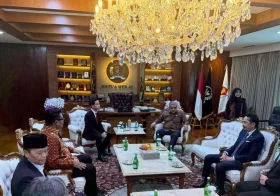
CNN Indonesia reported that Gibran arrived wearing a black suit, white shirt, and red tie, carrying a white folder while accompanied by security personnel. He waved to the media without providing a verbal statement. Gibran proceeded directly to the 7th floor of the MPR Chairman's office, where he was received by MPR Chairman Ahmad Muzani and several Deputy Chairmen.
Regarding the duration of his visit, BBC News Indonesia reported that the submission was brief, and Gibran left the location around 11:36 WIB. Conversely, Republika noted that the submission occurred around 11:30 WIB. According to CNN Indonesia, before heading to parliament, Gibran had bid farewell to officials and staff at the Office of the Vice President of the Republic of Indonesia.
MPR Chairman Ahmad Muzani confirmed the meeting. As reported by Republika, Ahmad Muzani stated:
"Gibran submitted his resignation letter as Vice President of the Republic of Indonesia. The same letter has also been submitted to Mr. Prabowo Subianto. Gibran requested that the letter be processed, and today the MPR leadership will hold a meeting regarding that resignation letter."
Republika
In a report by CNN Indonesia, Ahmad Muzani added a similar statement:
"The purpose of his visit was to submit his resignation letter from the position of Vice President of the Republic of Indonesia. According to him, the same letter has also been submitted to the President of the Republic of Indonesia, Prabowo Subianto."
CNN Indonesia
Background: Political Pressure and the Revocation of Educational Credentials
Gibran Rakabuming Raka's resignation follows intense political pressure from the DPR. As cited by BBC News Indonesia and CNN Indonesia, this pressure peaked after the Supreme Court (MA) issued a ruling invalidating the Certificate of Educational Equivalence for Gibran's high school level, which had been issued in 2019 by the Ministry of Basic and Secondary Education (Kemendikdasmen).
The Supreme Court ruling served as the basis for 120 members of the DPR from eight factions to propose the use of the Right to Express Opinion (HMP) to impeach Gibran from his position as Vice President. CNN Indonesia noted that this figure exceeds the minimum requirement of 25 DPR members to initiate the HMP. The proposal was submitted during a joint meeting between representative proposers and DPR leaders in the Commission VIII meeting room in Jakarta on Wednesday (11/11/2026).
DPR leader from the Nasdem faction, Saan Mustofa, issued a statement regarding the HMP proposal as reported by BBC News Indonesia:
"Based on the submissions from the representatives of each proposer, the total number of people proposing the Right to Express Opinion, based on those who signed, is 120 people from the eight existing factions."
BBC News Indonesia
News of the planned resignation had circulated a day earlier. According to BBC News Indonesia, Projo Chairman Budi Arie Setiadi confirmed the information on Wednesday (11/11/2026) with a brief "Correct." The decision to resign was also reportedly conveyed directly to President Prabowo Subianto on the same day.
Legal Dynamics and Differing Perspectives
Before finally submitting his resignation, Gibran had stated his intention to pursue legal channels. On Tuesday (10/11/2026), as reported by BBC News Indonesia, Republika, and CNN Indonesia, Gibran expressed his intent to file a judicial review (PK) and continue the lawsuit at the Administrative Court (PTUN) to prove the validity of his diplomas from elementary school through university. He claimed this step was based on advice from President Prabowo Subianto.
As quoted by CNN Indonesia, Gibran stated at the time:
"One of his suggestions was for me to keep fighting at the PTUN by presenting all documents from elementary school to university. And also to coordinate with the Ministry of Basic and Secondary Education to file a judicial review at the Constitutional Court."
CNN Indonesia
However, this claim was refuted by the Head of the Indonesian Government Communication Agency, Syahganda Nainggolan. Quoted by BBC News Indonesia (citing ANTARA on Wednesday, 11/11/2026), Syahganda referred to a statement by Coordinating Minister for Law, Human Rights, Immigration, and Correctional Affairs Yusril Ihza Mahendra, who emphasized that the Supreme Court and Constitutional Court rulings regarding Gibran's certificate are final and binding. Syahganda said:
"So it is impossible for the President to advise Gibran to continue legal resistance. Because Yusril is the President's Coordinating Minister for Law, meaning the President's legal view, in my opinion, is represented by Professor Yusril."
BBC News Indonesia
Constitutional law expert from the University of Indonesia, Titi Anggraini, explained to BBC News Indonesia that based on the principle of *ne bis in idem*, a lawsuit regarding the same object cannot be accepted. Titi stated:
"The first-instance Administrative Court ruling cannot cancel or set aside a Supreme Court cassation ruling because the Supreme Court is the highest court within the administrative judicial system."
BBC News Indonesia
On the other hand, a member of Gibran's legal team, Ade Darmawan, argued that the Constitutional Court and Supreme Court rulings contain formal flaws because his client was never directly examined. Ade told BBC News Indonesia:
"Let's wait for the evidence to be fair, because the legal principle is a fair trial."
BBC News Indonesia
Meanwhile, during the hearing of case number 255/G/2026/PTUN.JKT at the East Jakarta Administrative Court on Thursday (12/11/2026), the Ministry of Basic and Secondary Education, as the defendant, stated that it had revoked Gibran's educational equivalence certificate and requested that the case proceedings be terminated. The Ministry's attorney stated:
"Therefore, considering that we have revoked the object of this dispute, it is factually stated to no longer exist, we request that further examination of this case be stopped or not continued, Your Honor. As a copy, if Your Honor pleases, we would like to submit this document as a copy to Your Honor."
BBC News Indonesia
Constitutional Mechanisms Following Resignation
Based on a report by CNN Indonesia, referring to Article 8 paragraph (2) of the 1945 Constitution and Law Number 17 of 2014 concerning the MPR, DPR, DPD, and DPRD (UU MD3), the MPR will follow up on this resignation through the following constitutional stages:
- The MPR leadership holds a joint meeting to determine the schedule for a plenary session and officially notifies the President of the vacancy in the Vice Presidency.
- The President is required to propose two names of Vice Presidential candidates along with their requirement documents to the MPR leadership no later than 14 days before the plenary session is held.
- The MPR forms a special committee to examine the candidate requirement documents.
- The MPR holds a plenary session to elect a Vice President within a maximum of 60 days from the occurrence of the vacancy.
- All MPR members cast their votes to choose one of the two candidates, and the candidate who receives the most votes will be appointed and inaugurated as Vice President.
Regarding the timeline and inauguration, the UU MD3 specifically regulates these provisions:
"In the event of a Vice Presidential vacancy, the MPR shall hold a plenary session within a maximum of 60 (sixty) days to elect a Vice President."
Article 46 paragraph 1 of UU MD3
"The MPR shall inaugurate the Vice President as referred to in Article 46 paragraph (5) or paragraph (7) in an MPR plenary session by taking an oath according to their religion or a solemn promise before the MPR plenary session."
Article 47 paragraph 1 of UU MD3
Lessons and Leadership Ethics in Islam
In Islamic teachings, political office and leadership are heavy trusts (*amanah*) that will be accounted for before Allah. The decision to resign or resolve leadership dynamics in an orderly manner and within legal corridors can be viewed as an effort to maintain tranquility, unity, and national stability.
Islam teaches the importance of fulfilling trusts and being honest and fair in all government affairs. Allah says regarding the obligation to return trusts to those entitled to them:
۞ اِنَّ اللّٰهَ يَأْمُرُكُمْ اَنْ تُؤَدُّوا الْاَمٰنٰتِ اِلٰٓى اَهْلِهَاۙ وَاِذَا حَكَمْتُمْ بَيْنَ النَّاسِ اَنْ تَحْكُمُوْا بِالْعَدْلِ ۗ اِنَّ اللّٰهَ نِعِمَّا يَعِظُكُمْ بِهٖ ۗ اِنَّ اللّٰهَ كَانَ سَمِيْعًاۢ بَصِيْرًا ﴿٥٨﴾
Indeed, Allah commands you to render trusts to whom they are due and when you judge between people to judge with justice. Excellent is that which Allah instructs you. Indeed, Allah is ever Hearing and Seeing.
Qur'an, Surah An-Nisaa [4]: 58 (Sahih International)
Dynamics that occur in national and state life should be addressed with maturity, mutual respect for legal rules, and by always taking tafsir and lessons from every event. Considering the greater good of the *ummah* (the global Muslim community) and maintaining national stability is an important part of seeking peace and the ways to obtain blessings (*barakah*) in daily life.
Sources
- BBC News Indonesia: Gibran Rakabuming Raka serahkan surat pengunduran diri ke MPR
- Republika: BREAKING NEWS: Gibran Putuskan Mundur dari Kursi Wapres
- CNN Indonesia: Wapres Gibran Resmi Ajukan Pengunduran Diri ke MPR
- ANTARA: Wapres Gibran tiba di parlemen di tengah isu mundur dari jabatan
- Al Jazeera: Indonesian VP resigns over education qualification row