
EU-Indonesia CEPA Deal Cuts Tariffs on Over 90% of Goods
Indonesia and the European Union have signed the historic IEU-CEPA trade agreement, eliminating tariffs on over 90% of goods and saving 600m euros.
 Portal Islam
This article was first published in Indonesian. Baca versi Bahasa Indonesia →
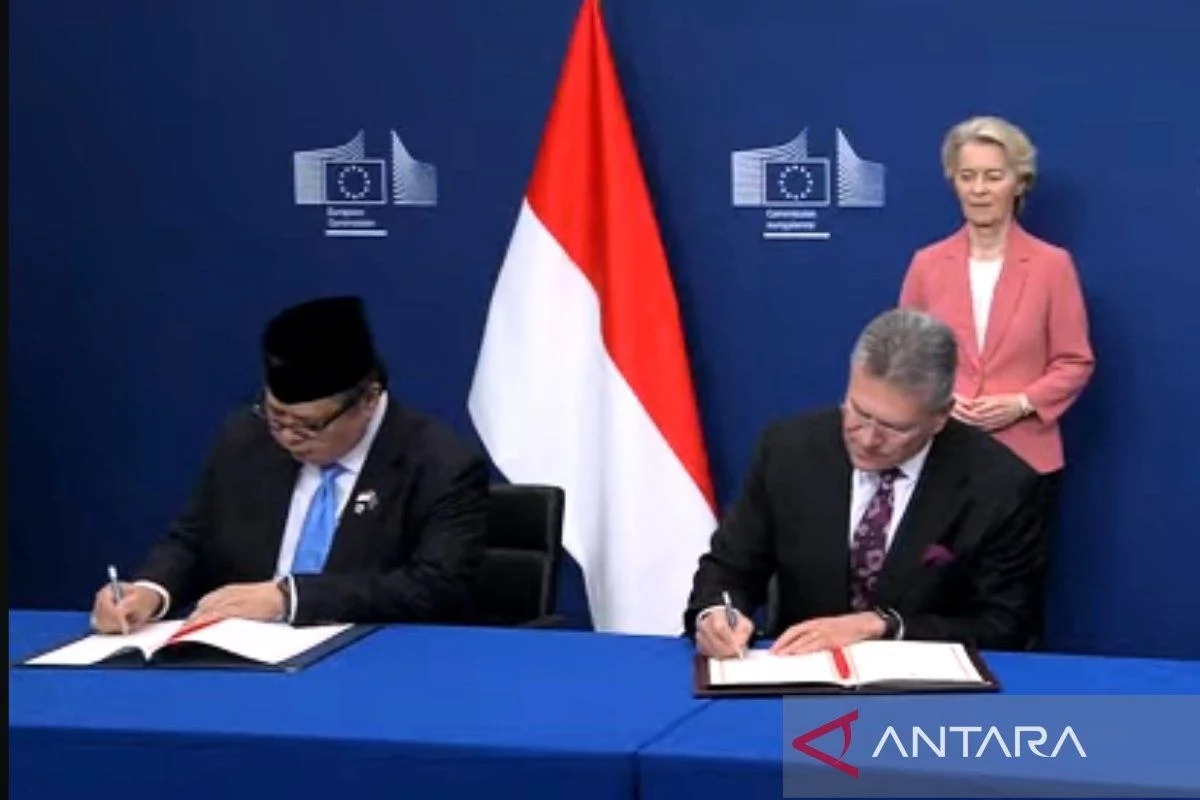
Indonesia and the European Union officially signed the landmark Indonesia–European Union Comprehensive Economic Partnership Agreement (IEU-CEPA) in Brussels, Belgium, on Saturday (21/11/2026). The historic pact agrees to eliminate import duties on more than 90 percent of goods traded between the two economies.
Indonesia's Coordinating Minister for Economic Affairs, Airlangga Hartarto, explained that the trade agreement is expected to save up to 600 million euros in trade costs annually. According to reports by Indonesian national news agency ANTARA and news outlet Republika, the agreement is targeted to take effect on January 1, 2027, following the completion of ratification procedures in all participating nations.
Tariff Cuts and Trade Savings Details
Speaking in an interview with international broadcaster France 24's World Roundup program, as cited in an official statement on Sunday (22/11/2026, UTC+7), Minister Airlangga noted that the IEU-CEPA will drastically slash import duties. Currently, several key Indonesian exports face import tariffs ranging between 7 and 12 percent in the EU market. Under the new pact, these duties will be reduced to zero percent.
The agreement grants wider market access for Indonesian export commodities to the European region, particularly benefiting labor-intensive industrial sectors. The zero-percent tariff reduction covers textiles, ready-made garments, food products, footwear, crude palm oil (CPO), and various other Indonesian agricultural goods. This achievement complements Indonesia's broader economic diplomacy, echoing similar initiatives such as Indonesia's international economic cooperation expanding across global partners.
Traded Goods and Sensitive Exemptions
In bilateral trade patterns, the European Union regularly exports non-electrical machinery, chemical products, and agricultural goods to Indonesia. Conversely, Indonesia exports agricultural produce, mechanical and electrical equipment, and manufactured goods such as footwear to the EU. The agreement serves as a crucial catalyst, as analyzed in discussions regarding IEU-CEPA and market access for Indonesian MSMEs, to bolster national export performance.
As part of reciprocal commitments, Indonesia will gradually eliminate import tariffs on 50 percent of vehicle tariff lines originating from the EU over a five-year period. However, the Indonesian government maintains strict protection for sensitive domestic commodities. As reported by Republika and ANTARA, the vehicle tariff reduction policy explicitly excludes key domestic agricultural commodities, namely:
- Rice
- Sugar
- Ethanol
Investment Protection and Ratification Urgency
According to ANTARA, alongside the IEU-CEPA signing, Indonesia and the EU also concluded the Investment Protection Agreement (IPA). The IPA framework covers legal protections for investors, state-to-state dispute settlement mechanisms, voluntary mediation facilities between investors and host states, and a framework for future bilateral negotiations.
Speeding up ratification is critical because Indonesia's preferential treatment under the Generalised Scheme of Preferences (GSP) is set to expire at the end of 2026. Any delay in ratification risks a regulatory gap before IEU-CEPA formally enters into force. To avoid trade disruptions, the EU requested signing the agreement on Saturday (21/11/2026) so document processing could begin internally by Monday (23/11/2026). Domestically, the government has consulted the DPR (Indonesia's House of Representatives)—amid ongoing public attention on legislative proceedings in the DPR—allowing ratification to be finalized via Presidential Regulation.
Environmental Standards and Industrial Sustainability
Addressing EU concerns regarding environmental standards and palm oil sustainability, Airlangga emphasized that Indonesia has maintained a strict deforestation moratorium for several years. Indonesia previously raised critical points regarding the EU Deforestation Regulation (EUDR), leading the EU to postpone its implementation by two years. Indonesia has confirmed its readiness to supply commodities that meet mutually agreed sustainability benchmarks.
In the mining sector, Indonesia continues to champion good mining practices. Compliance with environmental standards remains a mandatory requirement during mining audits and must be disclosed in corporate financial reporting. These practices have long been implemented by international mining companies operating in Indonesia, such as Freeport-McMoRan and Vale.
Response from the Economic Minister
Addressing negotiations amidst global economic volatility and US tariff policy changes, the Coordinating Minister stated that Indonesia maintains parallel negotiations with key global partners. Having secured bilateral agreements with both the United States and the European Union, Indonesia's trade position remains on a solid trajectory.
Airlangga expressed satisfaction with reaching this milestone for the national and European economies:
"I am always satisfied with the agreements we sign because this process involves so many ministers and EU leaders. In my view, the right momentum has finally been achieved despite the challenging geopolitical and geoeconomic landscape. Cooperation between Indonesia and the EU, as two major economic forces in Europe and ASEAN, can strengthen both economies and bring tangible benefits to our peoples."
Airlangga Hartarto, Coordinating Minister for Economic Affairs
Islamic Perspective: Upholding Fairness and Welfare in Trade
From the viewpoint of Islamic economics, mutually beneficial international trade cooperation (muamalah) is commendable whenever it is established upon principles of justice, honesty, and transparency. Removing tariff barriers while safeguarding vital staple foods such as rice and sugar reflects a commitment to the public interest (maslahah 'ammah), ensuring economic protection for smallholders, local farmers, and micro-enterprises.
Islam commands Muslims to fulfill commercial covenants and avoid harmful practices, including deception (gharar), speculative gambling (maysir), and interest-based exploitation (riba). Allah commands the fulfillment of solemn contracts in the Holy Qur'an:
يٰٓاَيُّهَا الَّذِيْنَ اٰمَنُوْٓا اَوْفُوْا بِالْعُقُوْدِۗ اُحِلَّتْ لَكُمْ بَهِيْمَةُ الْاَنْعَامِ اِلَّا مَا يُتْلٰى عَلَيْكُمْ غَيْرَ مُحِلِّى الصَّيْدِ وَاَنْتُمْ حُرُمٌۗ اِنَّ اللّٰهَ يَحْكُمُ مَا يُرِيْدُ ﴿١﴾
O you who have believed, fulfill [all] contracts. Lawful for you are the animals of grazing livestock except for that which is recited to you [in this Qur'an] - hunting not being permitted while you are in the state of ihram. Indeed, Allah ordains what He intends.
Qur'an, Surah Al-Maaida [5]: 1 (Sahih International)
By expanding fair export markets, business owners, Muslim families, and workers in labor-intensive sectors can earn a lawful and wholesome (halal and thayyib) livelihood. Furthermore, upholding environmental sustainability aligns directly with humanity's duty as stewards of the Earth (khalifah fi al-ardh) to preserve nature and attract divine blessings in shared economic pursuits.