Global Muslim Population: Pakistan Projected to Lead by 2070
Pew Research Center projects the global Muslim population to reach 3.64 billion by 2070, with Pakistan becoming the largest Muslim-majority nation.
 Portal Islam




This article was first published in Indonesian. Baca versi Bahasa Indonesia →
According to a report released by the Pew Research Center on November 18, 2026—and reported by Indonesian Islamic news site DetikHikmah alongside Al Jazeera—the global Muslim population is projected to grow significantly over the coming decades. Islam is expected to expand faster than any other major religious group, with the potential to surpass the global Christian population by 2035.
In its report titled The Future of World Religions: Population Growth Projections, 2020-2070, Pew estimates that the number of Muslims worldwide will increase by 80 percent, rising from 2.02 billion in 2020 to 3.64 billion by 2070. This demographic trajectory is primarily driven by high fertility rates and a relatively young population structure among Muslims.
Shifts in the Most Populous Muslim Countries by 2070
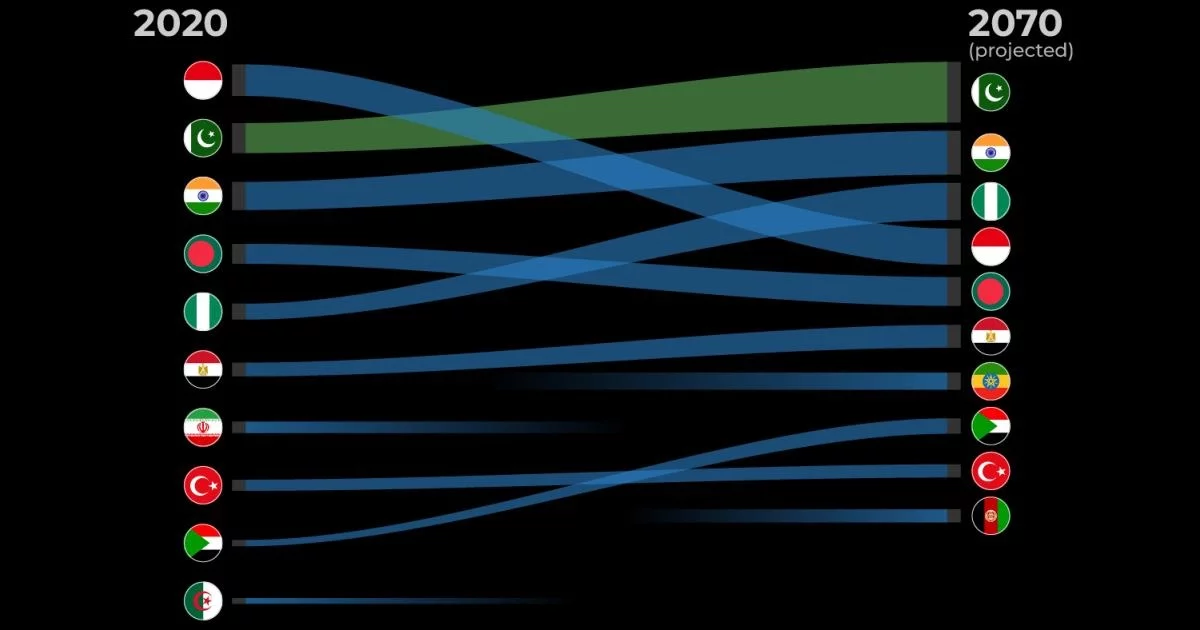
The Pew Research Center study, cited by DetikHikmah and Al Jazeera, indicates a major shift in the rankings of nations with the largest Muslim populations by 2070. Pakistan is projected to take over the top position currently held by Indonesia.
The top five countries by projected Muslim population in 2070 are as follows:
- Pakistan: Projected to rank first with an estimated 461.02 million Muslims, accounting for roughly 13 percent of the world's total Muslim population.
- India: Expected to place second with 333.62 million Muslims, even though Islam remains a minority religion in the country.
- Nigeria: Projected to reach third place with 282.13 million, fueled by rapid population growth across Sub-Saharan Africa.
- Indonesia: Currently the world's most populous Muslim-majority nation, Indonesia is projected to drop to fourth place with 273.86 million Muslims. The report clarifies that this shift is not due to a decline in Indonesia's Muslim population, but because population growth in other nations is progressing at a faster pace.
- Bangladesh: Projected to hold fifth place with a Muslim population of approximately 218.16 million.
Key Drivers Behind Muslim Demographic Growth
Further reporting by DetikHikmah notes that global Muslim population growth is heavily influenced by total fertility rates and age distribution. For the 2020–2025 period, the global fertility rate for Muslim women averaged 3.1 children per woman. This is higher than the average for non-Muslims, which stands at 2.0 children per woman according to DetikHikmah, or 2.5 for Christian women and 1.6 for other non-Muslim groups according to Al Jazeera data.
Additionally, the global Muslim population has a distinctly young age profile. As of 2020, the median age for Muslims globally was 24 years, compared to 33 years for non-Muslims. A younger demographic foundation provides greater momentum for future growth, as a higher proportion of the population is entering reproductive age.
As Muslims, we are constantly reminded to remain grateful for every blessing of life and to faithfully manage this demographic trust (amanah) by spreading goodness, embodying noble character (akhlaq), and remaining productive in our daily lives—a reflection of the standard maintained by a productive believer.
Pew Research Center emphasizes that these projections, covering 201 countries and territories, are based on the continuation of currently observed demographic trends—such as fertility rates, mortality, age structure, international migration, and religious switching—and do not represent absolute future certainties.